
Ecommerce Email Marketing: The Flows and Data That Actually Drive Revenue
Shopify can send your email for $1 per 1,000 after the first 10,000 a month. What it earns depends on which flows run: in Klaviyo's 2026 data, abandoned cart averages $6.77 per recipient and win-back $0.82.


Yes, Shopify can run your email marketing. Shopify Messaging (formerly Shopify Email) sends email, SMS and WhatsApp campaigns from the Shopify admin, with 10,000 free emails a month and $1 per 1,000 after that (checked Oct 2026, Shopify Help Center). Whether that is enough depends less on the tool than on which automated flows you run and whether your mail reaches the inbox. Klaviyo's 2026 benchmarks, drawn from more than 183,000 of its customers, put flows at nearly 41% of email revenue from 5.3% of sends (Klaviyo).
This guide gives you four things to act on: the flow build order with current revenue-per-recipient numbers, what Shopify Messaging costs at your list size, the Gmail and Yahoo rules that cap every send, and a rule for when to move to a dedicated platform.
Key takeaways
- Flows earn nearly 41% of email revenue from 5.3% of sends, and flow revenue per recipient is nearly 18x a campaign's (Klaviyo 2026 benchmarks, 183,000+ customers).
- Build order by average revenue per recipient (RPR): abandoned cart $6.77, welcome $5.75, browse abandonment $2.08, post-purchase $1.80, win-back $0.82 (Klaviyo, Oct 2026).
- Shopify Messaging: 10,000 free emails a month, then $1 per 1,000; abandoned-checkout automations never count toward the limit (checked Oct 2026). A 20,000-subscriber list mailed 8 times a month costs about $150.
- Gmail requires bulk senders (5,000+ messages a day) to use SPF, DKIM and DMARC, offer one-click unsubscribe, and keep spam complaints below 0.3%, with 0.1% as the target.
- Open rates are inflated by Apple Mail Privacy Protection. Judge flows by clicks, placed orders and RPR.
- Pricing for a done-for-you build is scoped per engagement; contact us.
The flows that carry email revenue, ranked
A campaign goes to the whole list at once. A flow fires for one shopper at the moment they act: start a checkout, join the list, place a first order. Klaviyo's benchmark page puts the gap at nearly 41% of email revenue from 5.3% of sends, a flow click rate of 5.58% against 1.69% for campaigns, and flow placed-order rates 13x higher (Klaviyo). A store sending three campaigns a week with no flows built is leaving the highest-yield sends unbuilt.
Klaviyo's October 2026 flow benchmarks (more than 110,000 customers) give a build order by average email RPR:
| Flow | Avg email RPR | Avg click rate | Trigger |
|---|---|---|---|
| Abandoned cart | $6.77 | 6.0% | Shopper adds to cart or starts checkout, then leaves |
| Welcome series | $5.75 | 6.5% | New subscriber |
| Browse abandonment | $2.08 | 5.6% | Product viewed, nothing added |
| Post-purchase | $1.80 | 5.1% | Order placed |
| Win-back | $0.82 | 2.8% | Customer lapsed past your repurchase window |
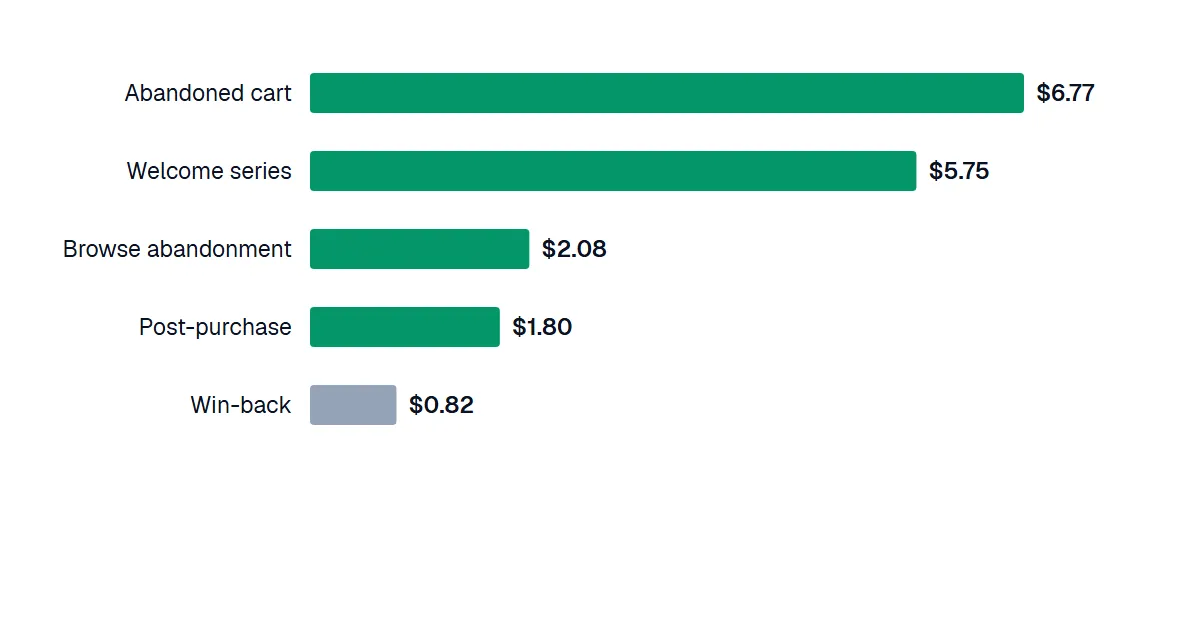
Abandoned cart and welcome earn the most per recipient. Source: Klaviyo abandoned cart benchmarks, average email RPR, published Oct 2, 2026, read on 2026-10-24. These are Klaviyo's averages; your store's numbers will differ.
What the ranking means for a build plan:
- Abandoned cart first. Baymard Institute's average across 50 studies is a 70.22% cart abandonment rate (Baymard, updated Sep 2025), so this flow has the largest pool of high-intent recipients in most stores. The top 10% of brands reach $13.70 RPR on it, twice the average.
- Welcome second. It turns a pop-up signup into a first order and is the first mail a new subscriber sees from you, which sets the engagement pattern mailbox providers read.
- Browse abandonment and post-purchase next. Lower RPR, but browse abandonment reaches shoppers who never got to the cart, and post-purchase is where the second order comes from.
- Win-back last for revenue, early for hygiene. At $0.82 RPR it earns little. Its job is to sunset subscribers who stopped engaging before they push your complaint rate up (see deliverability below).
Each flow needs timing tuned to your purchase cycle, dynamic product blocks, and a holdout group to prove the revenue is incremental rather than discounting orders that would have happened anyway. That is the bulk of what an email automation build delivers, and it is covered end-to-end in our marketing automation guide for DTC.
Shopify email marketing: what Shopify Messaging does and costs
Shopify Messaging is the renamed Shopify Email. Per Shopify's Help Center (checked Oct 2026):
- It sends email, SMS and WhatsApp campaigns from the Shopify admin; marketing automations are available for email and SMS.
- Abandoned checkout, abandoned cart and abandoned product browse automations start from templates edited in the Messaging editor. Custom automations, or ones that involve a third-party app, are built as workflows in the Shopify Flow app.
- Automation emails go only to subscribed customers and count toward your monthly sends. Abandoned-checkout automations are the exception: always free, never counted.
- Pricing is the same on Basic, Grow, Advanced and Plus: 10,000 free emails a month, then $1 per 1,000 up to 300,000, $0.65 per 1,000 after 300,000, and $0.55 per 1,000 after 750,000 (pricing page).
What that pricing means at common list sizes:
| Subscribers | Campaigns/month | Emails/month | Shopify Messaging cost/month |
|---|---|---|---|
| 5,000 | 4 | 20,000 | $10 |
| 20,000 | 4 | 80,000 | $70 |
| 20,000 | 8 | 160,000 | $150 |
| 50,000 | 8 | 400,000 | $355 |
| 100,000 | 8 | 800,000 | $610 |
Our calculation from Shopify's published tiers, checked Oct 2026. Assumptions: every subscriber gets every campaign; automation sends other than abandoned checkout are excluded and would add to the count; tiers applied to the cumulative monthly total. Taxes not included.
For comparison, Klaviyo's free plan covers up to 250 active profiles and 500 email sends a month; paid tiers are priced by active profile count on its pricing page (checked Oct 2026). The send cost is rarely the deciding factor. The deciding factor is whether the tool lets you segment and test flows the way your revenue requires, which is why the practical question is which platform to standardize on. Our Klaviyo vs Mailchimp comparison for DTC covers that choice directly.
Platform migrations carry a deliverability risk: importing a stale list and mailing all of it to "reactivate" it is the fastest way to raise complaints on a new sending setup. What to send, to whom and when decides whether the platform pays for itself, and that is the part a capable email marketing partner should own.
Email deliverability: the rules that cap every send
Perfect flows earn nothing in a spam folder. Since February 1, 2024, Gmail requires anyone sending more than 5,000 messages a day to Gmail accounts to authenticate with SPF, DKIM and DMARC, support one-click unsubscribe on marketing mail, and keep the reported spam rate below 0.3%, with below 0.1% as the guidance (Google sender guidelines). Yahoo set matching requirements, including the 0.3% complaint threshold (Mailgun). In November 2025 Google updated its FAQ to say enforcement was ramping up, with non-compliant mail increasingly deferred or rejected (Spam Resource).
For a store, this decides whether the abandoned-cart flow reaches the inbox. Good email deliverability services come down to ongoing hygiene:
- Authentication on your own domain: SPF, DKIM and DMARC aligned to your sending domain, not the platform's.
- Sunset flows: automatically suppress subscribers who stopped engaging, so you stop mailing addresses that only generate complaints.
- Sending to engagement: mail the most engaged subscribers first when warming a new domain or IP.
- Monitoring: watch Google Postmaster Tools and complaint rates weekly so a problem shows up in days.
None of this appears in a content calendar, which is why it gets neglected until revenue slides. It pairs with clean analytics and tracking so you can attribute what each flow earns.
Flows carry the revenue. Deliverability decides whether any of it reaches the inbox.
Open rates after Apple Mail Privacy Protection
Klaviyo's 2026 average open rate is 31% for campaigns and 32.2% for flows; the top 10% reach 45.1% and 45.8% (Klaviyo). Treat those numbers with care. With Apple Mail Privacy Protection (MPP) on, all images in a message are preloaded whether or not the recipient opens it, so the tracking pixel fires anyway. Klaviyo's own help center says this "artificially inflates your open rates" and that there is no way to tell an MPP preload from a real open (Klaviyo Help). The benchmark page doesn't say how MPP opens are treated in its averages.
Three practical consequences:
- Compare flows on click rate, placed-order rate and RPR, not opens.
- In Klaviyo, add
Apple Privacy Open = Falseto the "opened email" condition of engaged and sunset segments, so preloads don't keep inactive subscribers on the list. - A subject-line test judged on opens alone is mostly measuring MPP. Judge it on clicks.
Apparel email flows: why fashion is its own motion
For fashion email marketing, Klaviyo's industry table gives one useful number: clothing and accessories has the lowest placed-order rate of the 12 ecommerce industries listed, 0.97% for campaigns and 1.62% for flows (Klaviyo). Apparel needs more sends per order than other categories, which puts more weight on complaint rates and on flows that match a specific product to a specific shopper:
- Back-in-stock and size-availability triggers. Size runs out in apparel in a way it doesn't in most categories, so a "your size is back" flow has a natural audience.
- Creative carries more weight. In fashion the email is the product shot; flows lean on imagery and lookbook layouts, which connects to our creative production work.
- Drops and seasons set the calendar. Campaigns are built around launches; flows catch the browse and cart activity those launches create.
Working with an ecommerce email marketing agency
At some point the question becomes who builds and runs this. A full-time email marketer, a Klaviyo specialist, a deliverability person and a designer is a payroll line most growing DTC brands can't justify. An ecommerce email marketing agency covers the strategy, build and ongoing optimization without the headcount. What to check before hiring one:
- They start with flows and deliverability. If the first deliverable is a content calendar and nobody has audited your authentication or abandoned-cart flow, the funnel still leaks.
- They report on revenue. Email revenue, RPR, flow-level contribution and incrementality, not open-rate charts (which MPP inflates anyway). Email ROI claims vary widely: in Litmus's 2025 State of Email survey of nearly 500 marketers, 35% reported $10 to $36 back for every $1 spent (Litmus). Your number only exists if someone measures it.
- They know your vertical. Apparel needs size and back-in-stock flows; beauty needs replenishment timing. A generic playbook is the tell.
Synergy runs this as a done-for-you AI marketing automation service: we build the flows, set up deliverability and run the optimization as an operated program rather than handing over a self-serve login. Email usually anchors a broader done-for-you email and lifecycle program, and it slots alongside SMS automation for the moments where a text outperforms an email. For the full scope, see our DTC marketing automation overview; for subject-line testing, send-time optimization and content generation, see the AI email marketing for DTC guide.
Ecommerce email shortcuts we refuse
- We won't blast a stale list to "reactivate" it. Mailing addresses that haven't engaged in a year is the fastest way to trip the 0.3% complaint threshold. We clean and sunset first, even though it temporarily shrinks the sendable list.
- We won't discount our way to a "revenue" number. Blanket promo codes inflate email revenue by cannibalizing full-price orders. We test for incrementality so the reported lift is real.
- We won't skip the deliverability foundation to ship campaigns faster. If authentication and list hygiene are broken, email in the spam folder earns nothing. We fix the plumbing first.
Six of eight results are Shopify's own pages
On 2026-10-24, US desktop Google showed 8 organic results for "shopify email marketing" (one DataForSEO pull, n = 8), plus an AI Overview and a People Also Ask box.
| What ranks | Count (of 8) |
|---|---|
| Shopify-owned pages (product page, 3 Help Center articles, blog, App Store category) | 6 |
| Reddit thread asking why not just use Shopify Email | 1 |
| Third-party tool roundup (Omnisend, Klaviyo, ActiveCampaign, Mailchimp…) | 1 |
The AI Overview cited three domains, all Shopify's: shopify.com, help.shopify.com and apps.shopify.com. None of the eight results ranks flows by revenue, prices Shopify Messaging at real list sizes, or covers the Gmail and Yahoo sender rules, which is why this guide leads with those. The People Also Ask questions are answered below.
FAQ
Can Shopify do email marketing?
Yes. Shopify Messaging sends email, SMS and WhatsApp campaigns from the admin and runs email and SMS automations, including abandoned checkout, abandoned cart and abandoned product browse templates. Custom automations are built in Shopify Flow.
How much does Shopify email marketing cost?
10,000 emails a month are free on Basic, Grow, Advanced and Plus. After that it is $1 per 1,000 up to 300,000, $0.65 per 1,000 after 300,000 and $0.55 per 1,000 after 750,000. Abandoned-checkout automation emails are always free (checked Oct 2026).
What is the best email marketing tool for Shopify?
It depends on the flows you need. Shopify Messaging covers campaigns and template automations at low cost. Dedicated platforms such as Klaviyo, Omnisend and Mailchimp are the usual next step when you need deeper segmentation and flow testing; see the decision rule above and our Klaviyo vs Mailchimp for DTC breakdown.
Is email marketing still worth it in 2026?
For a store with automated flows, the data says yes: Klaviyo's 2026 benchmarks show flows generating nearly 41% of email revenue from 5.3% of sends. The return depends on deliverability; mail that fails Gmail's and Yahoo's sender requirements doesn't reach the inbox.
Platform, lifecycle and SMS reading for the email build
If you're deciding on a platform before anything else, start with the Klaviyo vs Mailchimp for DTC breakdown. To see how email fits the wider retention machine, the DTC marketing automation overview and our marketing automation guide map the full lifecycle. For the channel that pairs with email on high-intent triggers, see SMS marketing, and for how AI changes the build, the AI marketing primer. And because every flow above is a workflow that can silently fail, our guide to building marketing workflows that don't break covers the engineering discipline underneath.
To have your flows and deliverability built and run as an operated program, see the Synergy automation service page. Pricing is scoped per engagement; contact us for a scoped quote.