
AI Marketing Automation for DTC: What to Switch On First
Shopify, Klaviyo, Meta and Google already ship AI that drafts, tests and spends. The question for an operator is which of it acts on its own, and where a person still signs off.


AI marketing automation, for a DTC brand, is mostly already installed. Shopify ships an AI assistant on every plan, Klaviyo has an AI that builds flows and campaigns from a prompt, Meta and Google run AI-driven campaign types that pick audiences and move budget, and SMS tools generate and test copy variants on their own. The practical decision is which of these features you let act without a person, and the answer depends on two things: whether the tool drafts or acts, and whether its output touches money or customers. Below is that map for the tools a Shopify brand typically runs, with each vendor's AI feature and price checked in October 2026.
Gartner expects 40% of enterprise applications to include task-specific AI agents by the end of 2026, up from less than 5% in 2025 (via Gartner). The same firm predicts over 40% of agentic AI projects will be canceled by the end of 2027 on escalating costs, unclear business value or inadequate risk controls (via Gartner). Both can be true at once: the AI arrives inside your tools whether you plan for it or not, and the projects that fail are the ones with no boundary on what it may do.
Key takeaways
- The AI in a DTC stack splits into features that draft for review (Klaviyo Composer, Shopify Sidekick) and features that act on their own within settings you choose (Meta Advantage+, Google Performance Max, Postscript Infinity Testing, Shopify Flow, Zapier Agents).
- Klaviyo's help center states that a Composer draft "does not send or schedule" a campaign, and Shopify says Sidekick "presents changes for your review before applying them." For these tools the gate is built in; your job is to actually read the draft.
- The tools that act alone are gated through their settings: budget caps, brand exclusions, brand-voice rules, activity limits. Set those before switching the feature on.
- Start with work that is internal and reversible (audits, reporting, segment maintenance). Keep a person on anything that sets an offer, makes a product claim or moves meaningful spend.
- Of the eight pages ranking for "ai marketing automation" on 2026-10-24, we could load seven: none named Klaviyo Composer, Shopify Sidekick or Shopify Flow, and all seven named HubSpot.
- Pricing for a Synergy engagement is scoped per project. Contact us.
What is AI marketing automation in a DTC stack?
AI marketing automation is software that uses AI models to draft, test, target or execute marketing work that a person used to do by hand. In a DTC stack it shows up in three layers, and they carry different risk.
Rules-based automation with AI tuning. Klaviyo flows, Shopify Flow workflows, abandoned-cart triggers. The logic is if-this-then-that, written by a person; AI adjusts send times or suggests subject lines. Predictable because the rules are yours.
The AI marketing assistant. Generative AI that drafts copy, summarizes a dashboard, proposes a segment or a test. A person reviews and ships. This moves work faster without moving accountability, and it is where most of the low-risk value sits today.
Agents. Software that takes a goal, plans the steps and executes them across tools without a person approving each one. This is the layer with the most upside and the most ways to fail quietly. Our guide to AI agents for business covers how agentic workflows behave and the questions to ask before building one; this article stays with the AI features already inside the tools you pay for.
A vendor selling you the third layer while your flows and tracking are misconfigured is skipping steps. Our AI marketing automation work starts by getting the rules-based layer clean before any AI acts on it. For how email, SMS and paid fit together, the DTC marketing automation agency guide covers the full stack.
The AI already in your stack (checked Oct 2026)
Each row is taken from the vendor's own pricing page or help center, checked October 2026. "Acts on its own" means the feature changes something live (sends, spends, edits) without a per-action approval. Klaviyo's paid plans are priced by active profiles; the figures below are the entry tier. Prices change; check the linked page before you budget. The "Gate we'd keep" column is our recommendation, not the vendor's.
| Tool | AI feature | Drafts or acts? | Price (checked Oct 2026) | Gate we'd keep |
|---|---|---|---|---|
| Shopify | Sidekick, the built-in AI assistant: edits orders, writes product content, analyzes store data, builds Shopify Flow workflows | Drafts: "presents changes for your review before applying them" (help) | Included on Basic ($39/mo, or $29/mo billed yearly), Grow, Advanced and Plus (pricing) | Read every proposed change to prices, discounts or orders before applying |
| Shopify | Flow: trigger, condition, action workflows | Acts: runs on every matching event once turned on | Free app on Basic, Grow, Advanced and Plus (help) | Test on one tag or a small segment first; one owner per workflow |
| Klaviyo | Composer: audits and builds flows, campaigns and segments from a prompt | Drafts: "Creating a draft does not send or schedule it" (help); audits "do not automatically change your work" (help) | Free plan includes $5 of Composer usage a month; Composer at $20/mo gives 4× the free usage; Klaviyo estimates $0.10–$10.00 of usage per campaign created. Paid email plans start at $20/mo for 251–500 active profiles, email + SMS at $35/mo (pricing) | Check prices, discount codes, links, audience and filters in every draft before it goes live |
| Postscript | AI Plan: Brand Center, Infinity Testing, Shopper | Acts: Infinity Testing generates and tests "10 to 1000s of message variants" and learns from each send (page) | AI Plan $699/mo plus $0.003–$0.30 per message; SMS plans from $0/mo with a $49 monthly minimum (pricing) | Load claims and banned words into Brand Center; spot-check live variants weekly |
| Meta | Advantage+ sales campaigns | Acts: automated targeting, up to 150 creative combinations, one budget shared across ad sets (docs) | Campaign type in Ads Manager; you pay for media | Set the existing-customer budget cap; read results on a two-week window, not daily |
| Performance Max | Acts: Smart Bidding, budget moved toward "the highest performing inventory and placements," AI-generated image and video assets (help) | Campaign type in Google Ads; you pay for media | Brand exclusions on; review generated assets before they run | |
| Zapier | Zapier Agents | Acts across connected apps; a paid run stops at 40 activities and asks before continuing | Free plan: 100 tasks and 400 agent activities a month; Pro from $19.99/mo billed yearly (750 tasks); Agents Pro from about $33.33/mo billed yearly for 1,500 activities (pricing) | Start read-only; add an approval step before any write to Klaviyo, Shopify or the ad accounts |
Two things stand out. The email and store tools (Klaviyo, Shopify) ship their AI as draft-only by default, so the human gate already exists and the risk is a reviewer who clicks through. The paid-media and SMS testing tools ship AI that acts, so the gate has to be built from settings before launch.
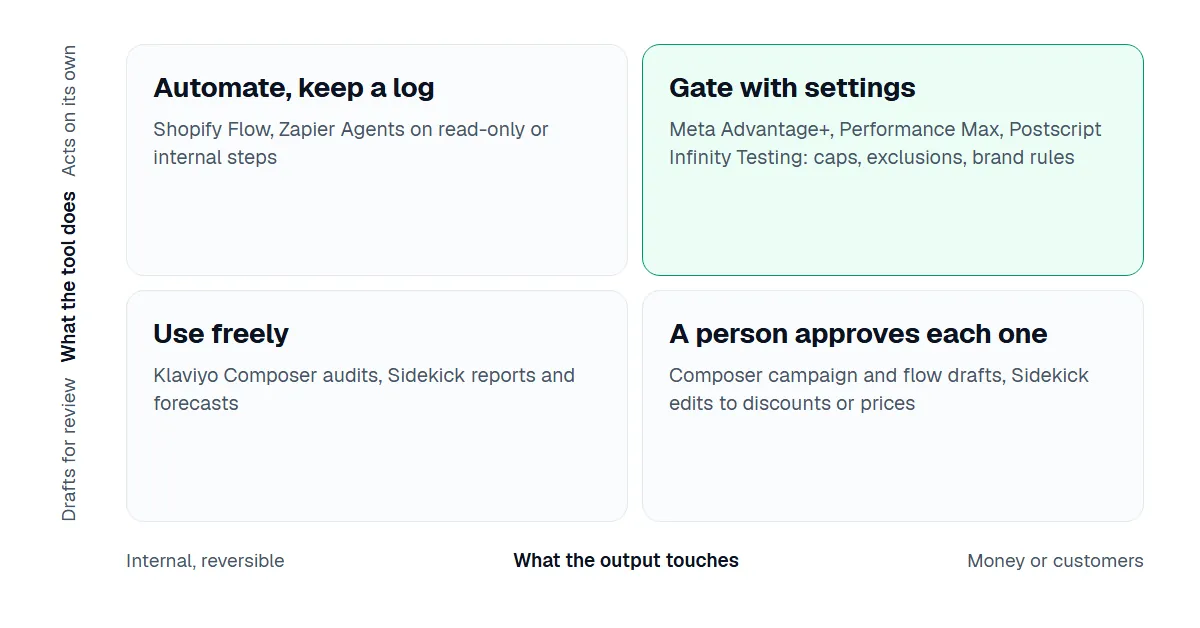
Where each AI feature sits, and the gate that goes with it. Source: vendor pricing pages and help centers, checked October 2026.
Where AI earns its place first
The tasks where AI pays off in a DTC stack share a profile: high volume, clear rules, reversible if wrong. For most Shopify brands that is a short list.
- Flow and campaign QA. Checking that every flow branch renders, links resolve and dynamic blocks populate is tedious, and attention lapses on it. Klaviyo's Composer audit is advisory and changes nothing on its own, which makes it a low-risk first switch to flip.
- Segmentation and list hygiene. Maintaining suppression rules, re-segmenting on behavior and flagging decaying engagement. A wrong segment is visible in its profile count before anything sends, so check the count before you save.
- Reporting rollups. Pulling spend, revenue and channel numbers into one weekly view is mechanical assembly. Pair it with a custom reporting setup and the human time goes to reading the numbers.
- First-draft creative and variants. Ten subject-line options or a first pass at ad copy is a real speed-up, as long as a person picks and edits before anything ships.
Nothing on the list sets an offer, makes a product claim or moves budget on its own. Our Synergy AI agents are scoped to this reversible tier by design and wired into the tools you already run. If you're deciding whether to build that capability in-house or hire it, the AI marketing agency comparison lays out the trade-off.
Generative AI marketing: the assistant, not the author
Generative AI is a drafting engine. Treating its output as finished is where brands get into trouble.
Unedited output fails in two predictable ways: it can state things that aren't true, and it can miss the brand's tone. Litmus notes that AI "can also overpromise with incorrect wording or even made up promotions," and that misleading subject lines "now carry real legal risk, with multiple class action lawsuits already filed" (via Litmus). Klaviyo's own review checklist for Composer drafts asks you to confirm prices, discounts and links in every message, which tells you where its drafts need checking.
Used that way, an AI marketing assistant multiplies output on volume-bound work: first drafts, subject-line variants, segment descriptions, campaign briefs, post-send summaries. We wire generative drafting into email marketing and SMS programs with a mandatory human gate. For the email-specific boundary (drafting flows without a machine setting the offer), see our AI email marketing guide. If you're still choosing the platform underneath, the Klaviyo vs Mailchimp for DTC breakdown covers where the automation lives.
Where automation quietly breaks a DTC brand
The failure is rarely a single blow-up. It is drift, and it comes from three places.
Automating judgment. Letting a system decide offers, positioning or claims. A model optimizing for opens can drift toward subject lines that each look fine and together wear down trust and deliverability.
Acting on thin signal. Budget or segment changes made on a two-day trend. Advantage+ and Performance Max already reallocate budget continuously; adding your own daily overrides on top of that doubles the reaction to noise. Read the two-week trend before anything structural moves.
Automating a broken foundation. Point automation at bad data and it scales the mess: dirty lists, misfiring tracking and duplicate profiles get amplified. This is why we insist on clean analytics and tracking before layering automation on top, and why lead-generation automation and builds like the LinkedIn content automation workflow only work once the underlying data is trustworthy.
Automate the mechanical. Keep the judgment human.
HubSpot on all 7 loaded pages, Shopify's own AI on none
Of the 8 organic results for "ai marketing automation" (DataForSEO, US desktop, 2026-10-24), we could load 7 (factors.ai timed out).
| What we counted | Pages (of 7 loaded) |
|---|---|
| Tool lists ("best AI marketing tools / automation software") | 3 of 8 results |
| Name HubSpot in the body | 7 |
| Name Klaviyo | 2 |
| Name Meta Advantage+ or Google Performance Max | 2 |
| Name Klaviyo Composer, Shopify Sidekick or Shopify Flow | 0 |
| Name Postscript or Attentive | 0 |
| Say, per tool, whether its AI drafts or acts | 0 |
DataForSEO organic snapshot, US, desktop, 2026-10-24, with People Also Ask and AI Overview cited domains. Each ranking page was downloaded the same day and tool names counted in the visible text (scripts and styles stripped). Counts are mentions, not a judgment of quality.
The ranking pages are written for a general marketing team with a CRM at the center. A Shopify brand's automation lives in Shopify, Klaviyo, an SMS tool and two ad platforms, and the useful distinction for that stack (draft versus act) isn't drawn on any of them. Google's AI Overview for the query cited ibm.com, reddit.com and academy.hubspot.com.
Limits we hold on AI automation work
- No autonomous decisions on money, claims or voice. We don't let an agent set offers, move meaningful spend or ship customer-facing copy without a human gate. Agents propose; a person accountable to your brand decides.
- No automation on a broken foundation. If your tracking is misfiring or your data is dirty, we fix that first. Automating on top of bad data scales the damage, and we won't bill you for it.
- No unattended black box. Every agent we deploy has a logged action trail and a human checkpoint on anything consequential.
FAQ
AI marketing is the use of AI models to draft, target, test or execute marketing work: writing copy variants, building segments, choosing audiences and bids, summarizing performance. AI marketing automation is the part of it that runs inside your tools without someone doing each step by hand.
No. Klaviyo's help center says a Composer draft "does not send or schedule" a campaign, and flows it builds are created as drafts you set live yourself. Audits recommend changes but don't apply them. Rules-based flows you've already turned on keep sending as before.
The internal, reversible ones: Klaviyo Composer audits, Sidekick reports, segment maintenance and weekly reporting rollups. They save time without touching customers or spend. Features that act on budget or send customer-facing copy come after their limits are configured.
Much of it is bundled: Sidekick and Shopify Flow come with every Shopify plan, Klaviyo's free plan includes $5 a month of Composer usage, and Advantage+ and Performance Max are campaign types you pay for through media. Dedicated add-ons cost more, for example Postscript's AI Plan at $699 a month (checked Oct 2026).
Agency, platform and channel guides for the next decision
If you're deciding whether to build this in-house or bring in a partner, start with the AI marketing agency comparison, then the marketing automation agency for DTC guide for how the flows are architected. If the open question is which software to run it on, the marketing automation platform guide covers the self-serve versus done-for-you decision. For the channel-level builds, the email marketing and SMS marketing breakdowns cover where automation earns its keep, and the DTC marketing automation agency piece ties the stack together. For the email strategy this automation feeds, our ecommerce email marketing guide covers the flow economics. And since none of it matters if the mail never lands, our email deliverability services guide covers the infrastructure underneath.
Done-for-you AI automation, built and run for you with a person kept on every consequential decision, is priced per engagement. Contact us for a scoped plan.