
If you have a business — or you're about to start one — you need a growth OS, not more tools
Solo founders, small business owners, in-house teams of one. The advice 'just hire a marketer' or 'just use this tool' is broken. Here's the shape of what actually works.


You don't have to be running a venture-backed startup to feel this. The freelance designer with three clients feels it. The woman opening her second coffee shop feels it. The founder of a five-person SaaS feels it. The marketing-team-of-one inside a 200-person company feels it.
The shape of the problem is the same in all four cases: the work of growing a business has fractured into a dozen tools, and no one of them owns the result.
You don't need another tool. You need the seams between the tools to disappear.
The advice you've been getting doesn't work anymore
For a long time, the standard playbook for "I have a business, I need it to grow" went something like:
- If you're a solo founder: "Just learn it yourself. Read some blogs. Do the marketing on weekends."
- If you're a small business owner: "Hire a marketing agency. Or freelance someone on Upwork."
- If you're a small team: "Buy the tools. HubSpot. Webflow. Ahrefs. Notion. Hire a marketing manager."
Each of these used to work — barely — when the bar was lower and the toolchain was simpler. None of them work well in 2026.
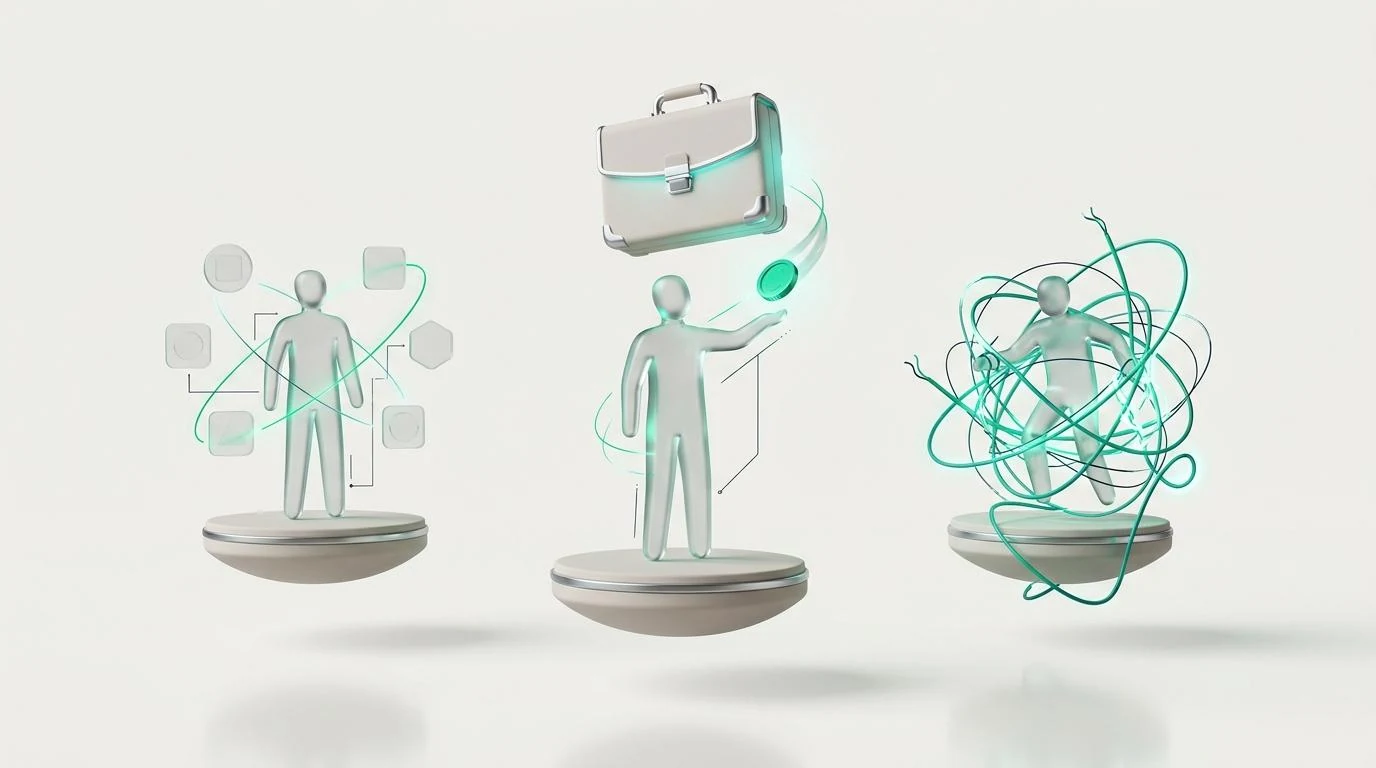
Doing it yourself
The solo founder problem
You don't have the time to learn six different products. By the time you've figured out keyword research, your competitor has shipped twelve pages. By the time you've set up tracking, the platform changed its tags. You're not bad at marketing — you're just one person, doing the work of six tools.
Hiring it out
The small business owner problem
Hiring an agency or a freelancer used to mean "I get a marketer." Now it means "I get a project manager who coordinates six tools on my behalf, and bills me for the coordination." The output is fine. The cost-per-result has quietly doubled.
Stacking tools
The small team problem
You bought the tools. Each one is good at its slice. Together they form a graveyard of tabs, none of which know about the others, and a Monday meeting where three people try to reconcile their numbers on a whiteboard.
The problem isn't the people, the tools, or the budget. The problem is that the work itself has more seams than any one person or tool can hold.
What an "OS" actually means here
The word "operating system" gets thrown around a lot. Here's the concrete version.
An operating system for growth is the layer that:
- owns one source of truth about your site, your pages, your audience, your content, your experiments, your conversions — not six tools each with their own version,
- owns the workflows, not just the screens — "find a gap → draft a page → publish → tag → measure → iterate" is one workflow, with one log, not six separate tools chained with Zapier,
- lets you hand the boring half to an agent — overnight, the OS fixes a broken meta description, redrafts three product snippets to match new positioning, and leaves a one-line note explaining why,
- gives the same view to a human and to an agent — so you can hand off work without translating between dashboards.
You can read all of that as "fancy automation." It isn't. The point is subtraction, not addition.

What this looks like for each of you
The same underlying system shows up very differently depending on who's using it.

The shift in mindset
The mental model that used to work — "I'll buy the right tools and figure it out as I go" — is the same mental model that produced the graveyard of tabs.
The mental model that works now is:
- Pick the workflow, not the tool. What's the end-to-end motion you actually need to run? "Find a gap → draft → publish → measure" is a workflow. "I have Ahrefs" is not.
- Insist on one source of truth. If two of your systems disagree about what a "conversion" is, you don't have a marketing problem — you have a definitions problem, and it will quietly poison every decision you make.
- Hand work to agents the moment it stops being a decision. If you're doing the same thing every Tuesday at 9am, an agent should be doing it. Your job is the judgment call, not the labor.
- Measure the system, not the channel. "Google Ads worked this month" is a vanity sentence. "We turned a $30 click into a $4,800 LTV customer in 47 days" is a system sentence.
You don't need to be sophisticated to do this. You need a tool that takes this view of the world by default — so you don't have to assemble it from parts.
What this is really a bet on
Building an OS for growth is, at the core, a bet that the people running real businesses — solo, small, growing — deserve the same operational leverage that big in-house marketing teams have.
The current world doesn't give them that. The current world gives them either a dozen single-purpose tools to wire together themselves, or an agency that costs three months of runway. Both of those are answers from a world where automation was rare and judgment was the easy part.
We're in the opposite world now. Judgment is the scarce thing. Labor is cheap, and getting cheaper. The right product makes the labor disappear and gives you back time to make the calls only you can make.
That's the bet. If you're starting a business this year — or you've been running one for a decade — that's the bet worth taking.